Replacing pre-1940 tractor tyres sized 11.25, 12.75 or 13.5
On a couple of occasions, we have had customers looking for 11.25-28 tyres for their tractors. The first time this happened, we tried an 11.2-28 and a 12.4-28, but the customer always reported that while the tyres fitted, the tractor was too low at the back and did not look right at all.
A bit of internet research then revealed the problem. 11.25 is a really old size, in fact it goes back to the introduction of rubber tyres on tractors in the first quarter of the 20th Century. Writing in an article for Farm Collector magazine in the United States (US), former Goodyear employee Ted Buisker revealed that right up to the 1940s, just about all US tractor tyres were fitted to eight-inch rims. This had the effect of making the tyres taller.
"After rubber tyres on tractors became more accepted, it was discovered that wider rims contributed to better tyre performance," he wrote. "The wider rims actually made the tyre wider because the beads were no longer pulling the tyre together. Tyres labeled “11.25” were 13 inches across at the shoulders. The tread was allowed to flatten out some and the tyres became more efficient.
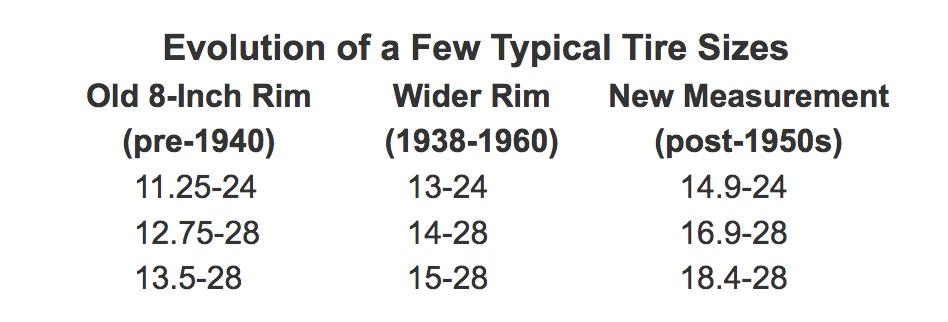
"As recommended rim width increased, tyre numbers followed – but tyres remained the same. The industry resized tyre numbers to reflect the new recommended rim width. As an example, let us use the 11.25-24 tyre, as used on the early tractors with eight-inch-wide wheels. This became the 13-24 when used on a 12-inch-wide rim.
"Later on, in the late 1950s or early 1960s, the manufacturers again renumbered their tyres. These new numbers referred to overall carcase width when mounted on the recommended rim width. With this change, our 13-24 grew to a 14.9-24."
So, if you have an old 11.25-24 tyre, you may need to replace it with a 14.9-24 to get the same overall diameter on your axle. Clearly this falls outside the usual recommended fitment for modern tyres – and as such you do it at your own risk – but it does give the tractor the correct, authentic look.
The complete article can be found at: www.farmcollector.com/tractors/getting-around-to-tires
A good way to double-check the tyre you need to maintain the correct "look" of your tractor is to use the static loaded radius (SLR) figure for the tyres. This is the distance from the ground to the middle of the axle hub when the tyre is fitted to the tractor and inflated to its operating pressure. This is normally less than half the tyre's overall diameter.
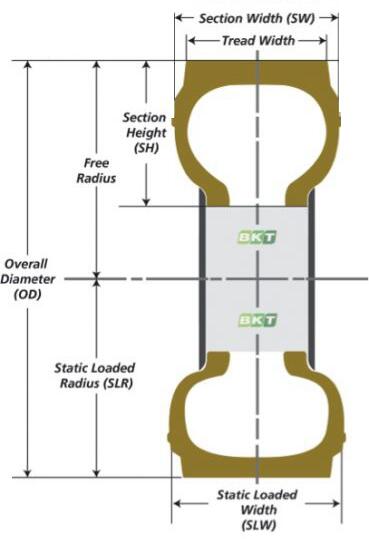
By establishing the SLR for the tyres you are replacing (and adding a little extra for tyre wear if required), you can check the data charts for the tyre rim size you need to find which one will provide the required SLR and put the rear axle at the correct height. In a perfect world the tyre you need will be approved for the wheel rim width.
Our crossply drive tyres can be found HERE